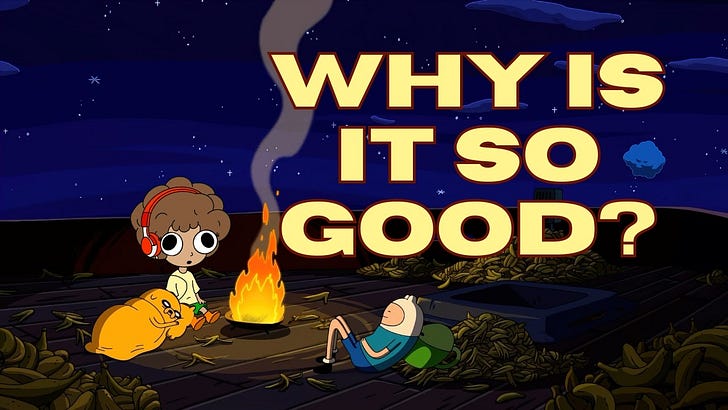
Exploring the music of adventure time
Words by
Triston
"Yaps On Record"
Imagine trying to create an entirely new soundtrack for a cartoon for today’s generation.
Where do you even start? What does that sound like? What does it feel like?
When I started asking myself those questions, one of the first places I kept landing was a show that came out over a decade ago. And not just because it’s nostalgic for me, but because it served as the foundation for so many other unique cartoon sounds.
Let’s break down exactly how they did it because understanding their lore & process changed how I think about my own work & and I think it might do the same for you.
If you want to watch the lovely YouTube video paired with this Substack, you can find it below :D
The Indie Beginnings:
The primary composers across most of the show’s run were Casey James Basichis and Tim Kiefer. What’s interesting about them is that they didn’t come from a traditional animation scoring background.
Most composers come up through orchestral training or film score programs, but these two came from their band together called Casey James & the Staypuft Kid.
I believe that that’s where a lot of the whimsy comes from. It’s not overly calculated music theory but just what happens when people who genuinely love strange and unique sounds are handed a cartoon world and told to make it feel real.
When yapping about how they decide which sounds fit where & decide how to mold these pre-existing genres to create something new casey notes that he “wanted an atmosphere gripped with juvenile silliness and unbiased curiosity, recalling the time in life where everything is new. The music intentionally injects foreign elements into the space, dragging and shoving the audience into new realities; good-natured roughhousing.”
What I got from that is that he wanted to capture that childlike whimsy while also giving the show personality and texture to immerse audiences into each different episode and the world within each one.
I’ve been a huge HUGE fan of adventure time ever since I was little. I used to have a mini BMO figuring, Finns sword and hat, and even the Enchiridion.
I even remember there was this game called Mixit that Cartoon Network had on their website where you could make music by choosing clips and templates from various CN shows like The Amazing World of Gumball, Regular Show, or just clips and templates from Adventure Time.
That was the first time I really saw unique the music from Adventure time was and
Now if you’ve been reading/watching me for a bit, you already know the four things I look for in a project that actually feels like a world: story, interpretability, visual identity, and architecture. I broke all of this down in my last video, so you should definitely check that out if you haven’t yet but Adventure Time’s music has all four of these characteristics.
Now we’re only going to look at a few songs of the 100+ that were created so bare with me.
Story
Most cartoons use music the way you use background noise. It fills the space and you don’t typically notice whatever’s playing but Adventure Time uses their music almost like a narrator and really communicates the feeling of what’s happening in a scene to push the narrative forward. Take the BMO Noir episode for example. On the surface it reads like a filler episode because BMO plays detective while Finn and Jake are away but the music tells you exactly what kind of world you’re in. There are traditional noir film undertones, jazz notes, an electronic piano, but underneath all of it synths & bells hitting inconsistent tones and unresolved chords. Nothing quite lands where you expect it to. That unease is intentional, because this is the world through BMO’s eyes in this episode. The music isn’t just scoring what’s happening; it’s also scoring how BMO feels about what’s happening.
From the more imperative plot lines of the show we can can look at the “I Remember You” song sung by the Ice King and Marceline. For context Ice King shows up at Marceline’s door wanting to write a song together. He brings an omnichord, a drum set, and a stack of old letters he wants to use as lyrics. To him it’s just a jam session but to Marceline, those letters are deeply emotional lyrics written by Simon Petrikov, the man Ice King used to be before his magic crown slowly erased his mind, the man who raised her in the post-apocolyptic world. Ice King, becuase of the crown, unfortunately doesn’t understand nor remember the emotional meaning of the lyrics but Marceline does and the music throughout the scene holds onto that tension.
The chords are electronic, inconsistent, and haunting with no clear key center. Nothing resolves, nothing settles, and it ties into the story because emotionally nothing can ever really settle if that makes sense. Marceline is reading a thousand-year-old letter from someone who no longer exists, and instead is singing it back to the person he became. Ice King’s drumming is bombastic and completely arrhythmic (irregular rhythmn) & the aloofness in his playing is proof of his madness. He’s a beat behind everything, out of step with his own song, until Marceline guides him in. Even though he doesn’t know or understand why the words matter - she does and that gap between his oblivion and her grief shows & lives entirely in how the music is constructed.
Adventure Time consistently lacks a consistent palette but more or less creates different soundscapes across the show that communicates multiple different stories within the main plot.
Interpretability
To me, some of the best songs are able to be understood or be able to be interpreted by almost anyone if that makes sense.
There’s an episode called Incendium where Finn is completely broken up over Princess Bubblegum (per usual) and BMO plays this 8-bit, chiptune song called “All Gummed Up Inside.” It’s a more melodic, genuinely catchy song but later in the episode Jake ends up performing a flipped version of it for Flame Princess. Watching it as a pre-teen, you just know Finn is sad - that much is obvious. Watching it again as a young adult who’s actually been through it - who’s felt that specific confusion of not knowing what to do with feelings you don’t have words for yet overwhelm you.
What I appreciate most about Finn as a character is that he gets it wrong sometimes. He reacts badly and he makes mistakes, but watching him navigate that, sometimes appropriately and inappropriately has honestly saved me from some of my own mistakes.
And like it’s been said before, nothing in the show captures that better than “Everything Stays.” If you’re little watching this it may seem like just a somber lullaby but if you’re in your twenties and you just left something behind a place, a person, a version of yourself you can’t get back this song opens something up in you. As someone who’s gone all the way out here to California to pursue her creative endeavors, everything at home stayed but also changed. The song is a literal contradiction & also one of the realest songs I’ve heard and resonated with in a cartoon about growing up.
Rebecca Sugar, one of the storyboard artists and writer on the show wrote the song among so many other bangers on this show but the fact that songs like this were tucked inside a kids’ cartoon, songs that kids could grow into over years without realizing it honestly says everything about the intention and care behind the project.
Visual Identity & Architecture
When I think about architecture in music, the motifs, the recurring melodic DNA that threads through a project and makes everything feel connected - I assumed Adventure Time had a system. Some underlying musical logic tying it all together, and then I found out it doesn’t. There are virtually no recurring themes or motifs across the scores, which should feel like a problem, & somehow it isn’t.
So if there are no recurring motifs, what is the architecture?
I think it’s the texture itself. (bruh count how many times the word texture is in here LMAO). The consistent lo-fi warmth, the handmade quality, and the emotional honesty sitting underneath even the silliest moments are very consistent. They could go from Finn singing “I’m a tough tootin baby, I can punch-ah yo buns” all the way to the devastation of “I Remember You” without it ever feeling like two different shows.
The visual and sonic identities are the same, like you could close your eyes and still know what world you’re in. A motif is a short, recurring melody or rhythm that runs through a project, making everything feel connected. When it’s done right, you don’t consciously notice it. You just feel like the whole thing holds together.
Basichis and Kiefer built a score that could go from Finn singing “I’m a tough tootin baby, I can punch-ah yo buns” all the way to the devastation of “I Remember You,” without ever feeling like two different shows. That range only works because the texture stays consistent. The warmth, the handmade textures, the emotional honesty underneath even the silliest moments as a thread never breaks.
Quest Completed
As Jake the Dog says “Music is powerful, man. It speaks to a primal pit in our brains.” He’s right and I think Adventure Time is one of few shows during that time that understood it. Before you head out, I decided to sample some of the songs & episodes from the series so come along with me and check out my adventure.
(See what I did there? I’m sorry.)
Here’s a few of my fav songs that go a bit unmentioned that I think are really great examples of all four of the characterstics I mentioned:
Not just your little girl by Marceline
Rap Bear & Finn’s Rap
Flute Spell scene
Nuts / You’re so annoying by Marceline
Everything Stays by Marceline
Resources:
Originally published on Substack